
SoBigData Academy Camp 2026
Overview
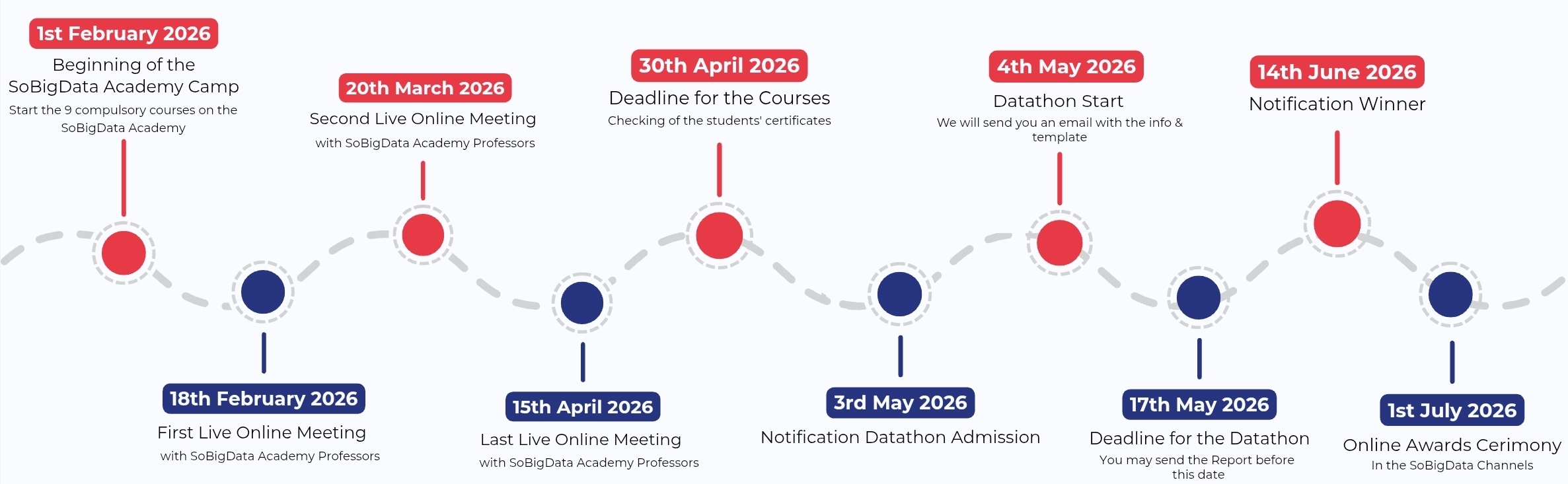
Students Registration: Open the 1st January and close the 31st January 2026.- CLOSED- Duration: 3 months (from 1st February to 30th April 2026).
- Datathon: Students that completed the courses will be invited on the 1st of May to the Datathon.
- Format: Online learning + interactive events + final Datathon project (optional).
- Workload: Around 37 hours of flexible online courses (≈5 hours per week).
- Target students: Open to all levels (no prior background required), especially students outside traditional computer science or engineering (e.g. sociology, political science, law, humanities) who are interested in statistics, data analysis, and social data.
What Students Will Do
- Complete a selection of free SoBigData Academy courses (approx. 37 hours over 8 weeks, ~5h/week).
- Join monthly online events where teachers and invited experts share use cases and answer questions.
- Receive a Certificate of Participation signed by SoBigData Research Infrastructure.
At the end of the program, the students will be invited to participate in a Datathon challenge (May 2026), applying their new knowledge to analyze a real dataset and present results in a short report. The best projects will be awarded with a dedicated interview and blog post on the SoBigData channels and a €500 prize for the global winner.
Why Involve Your Organizations and Institutions?
This initiative is a valuable opportunity to offer a free, structured, and interdisciplinary learning experience in data science. By sharing this program, you can help students gain practical experience in data analysis, ethics, and innovation, competences that are highly valued in research, professional careers, and today’s data-driven society.
For additional details: info@sobigdata.eu.
To receive updates and dissemination materials for your institution, fill in the following form: https://forms.gle/jhRqoT6JhPakhcGGA .
Courses and Competences Gained by Students
| Course | What it covers | Competences acquired | Possible applications |
|---|---|---|---|
| Basic Python | Introduction to one of the most used languages in data analysis. | Basic programming and data manipulation. | Automating small research tasks, reading data files, and manipulating data. |
| Database | How data is stored and retrieved in structured systems (e.g. university datasets, surveys). | Understanding data organization and SQL basics. | Understanding database structures, populating them with data, and retrieving information. |
| Data Analysis | How to explore, describe, and interpret data patterns. | Descriptive statistics and analytical reasoning. | Evaluating datasets, comparing, and producing indicators. |
| Data Mining & Machine Learning | How computers can find patterns or predict trends. | Fundamental understanding of algorithms and their ethical implications. | Identifying trends in data and hidden patterns and rules. |
| Legal & Ethical Aspects of Data Science | How data use interacts with law, privacy, and ethics. | Awareness of GDPR, the AI Act, and data governance. | Evaluating responsible data policies in projects and institutions. |
| Data Theory & Society | Understanding data’s social, cultural, and political dimensions. | Critical thinking about technology and society. | Research on digital democracy, media, and social impacts. |
| Complex Network Analysis | How relationships between entities can be represented as networks. | Basics of graph thinking and visualization. | Mapping networks such as social, collaborations, or institutional structures. |
| Business Model Data-Driven Innovation | Using data to create value and innovation in organizations. | Strategic planning and innovation mindset. | Designing business or policy models informed by data. |
| Data Visualization & Visual Analytics | Presenting information clearly through visuals. | Data visualization and communication skills. | Making understandable and meaningful graphic representations of results. |


